
7-Axis Collaborative Robot Yamaha Motor Cobot
The Yamaha Motor Cobot is a 7‑axis collaborative robot developed by Yamaha Motor. It offers an arm reach of 1,300 mm and a maximum payload of 10 kg, supporting a wide range of applications including screw tightening, visual inspection, sealing, connector insertion/removal, and polishing.
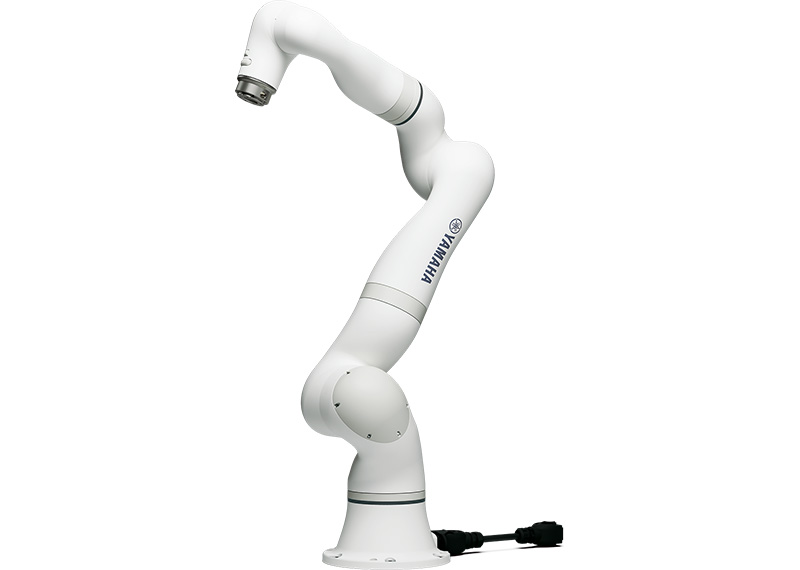
Yamaha Motor Cobot It supports a wide range of applications, including screw tightening, visual inspection, sealing, connector insertion/removal, and polishing.
With its human‑arm‑like 7‑axis configuration and torque sensors integrated into all axes, the robot delivers smooth, compliant motion and enables flexible operation in narrow spaces or during complex approach paths.
- Arm Reach:
1300mm - Maximum Payload:
10kg - Maximum Speed:
3000mm/s (TCP/High-speed mode) - Repeatability:
±0.04mm (ISO9283) - Body Weight:
45kg
Feature
Difference from General 6‑Axis Robots
While most collaborative robots use a standard 6‑axis configuration, the Yamaha Motor Cobot adds an additional “third axis,” resulting in a 7‑axis structure.
This extra degree of freedom enables arm postures closer to those of a human arm.
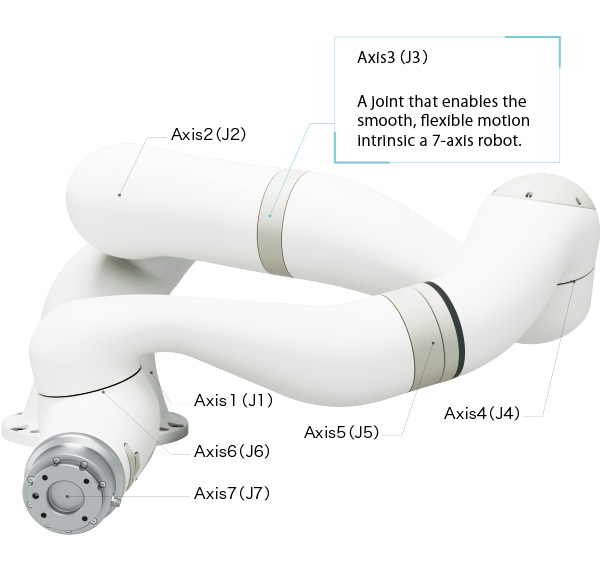
Comparison: Yamaha Motor Cobot (7‑axis) vs. Typical 6‑axis Robots
| Typical 6‑Axis Robot | Yamaha Motor Cobot (7‑Axis) | |
|---|---|---|
| Number of axes | 6 DOF | 7 DOF |
| Arm posture | Determined by 3D coordinates + orientation | Additional +1 DOF allows higher flexibility |
| If interference occurs | Layout changes required | Can change robot posture without layout change |
The plasma cleaning process uses products from FUJI CORPORATION.
The sealing process uses products from ThreeBond Co., Ltd. and Musashi Engineering, Inc.
The screw tightening process uses products from SANYO MACHINE WORKS, LTD.
The visual inspection process uses products from Phoxter Corporation
Watch actual operation(Yamaha Motor Robotics Official YouTube Channel)
Yamaha Motor Cobot: Key Features & Overview
01
- What processes is it suitable for?
-
The Yamaha Motor Cobot is ideal for operations in confined spaces, tasks requiring wrap‑around motions enabled by its 7‑axis structure, and processes that need compliant motion such as connector insertion/removal or surface polishing using built‑in torque sensors.
With the available High‑speed Mode, it can also be used as an industrial robot when combined with appropriate safety measures such as installing safety fences and performing risk assessments.
Note: Risk assessment must be conducted by the customer.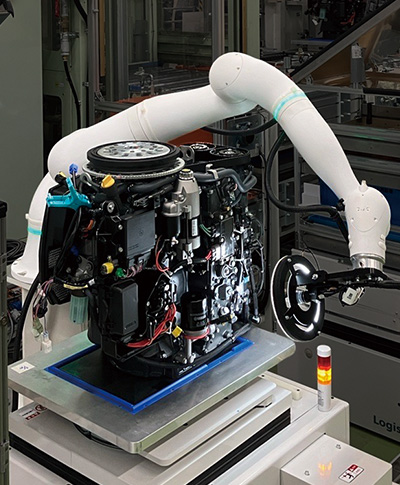
02
- Can it perform delicate tasks?
-
Yes. Torque sensors are built into all seven axes, enabling compliant control and smooth motion.
It can precisely detect slight external forces, allowing smooth “follow‑the‑surface” movements for connector insertion/removal, curved‑surface polishing, and gear fitting.
03
- What is the repeatability?
-
Repeatability is ±0.04 mm, making it suitable for precision tasks.
04
- Is third‑party safety certification available?
-
Yes. The robot has obtained TÜV SÜD functional safety certification.

05
- Is the programming beginner‑friendly?
-
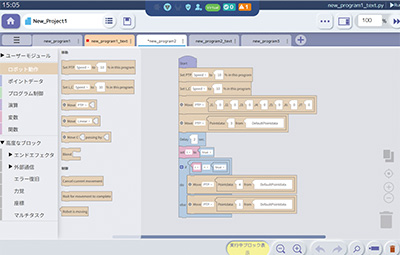
Yes. Block‑based programming allows users to create programs by combining predefined command blocks.
Text‑based programming is also supported. Even first‑time users can operate the robot intuitively.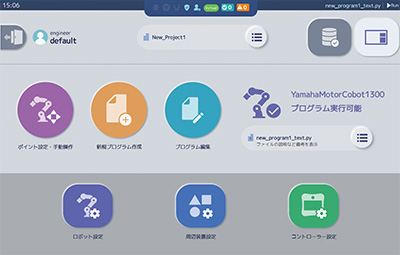
06
- How large is the controller?
-
The compact controller measures 374mm (W) × 323mm (D) × 155mm (H).
Controller Specifications Input voltage range DC 48 V ±5% Power capacity (drive) 48V 30A max Power capacity (control) 48V 10A max 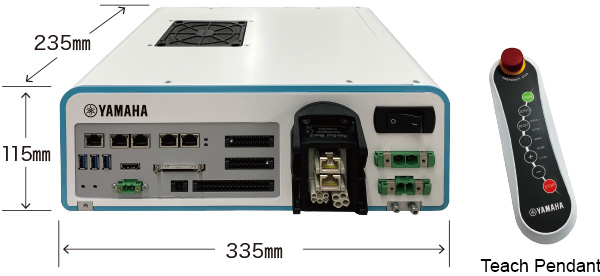
07
- Can it be integrated with AGVs or AMRs?
-
Yes. Since the controller operates on DC 48 V, it can share the same battery with AGVs and AMRs.
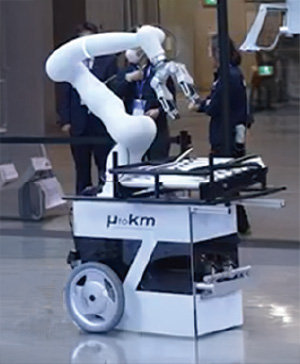
Exhibited at the 2023 International Robot Exhibition
Cobot × AGV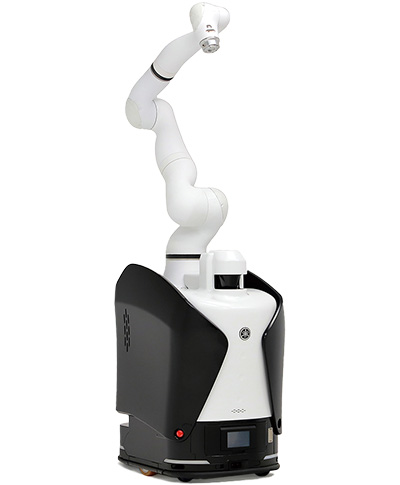
Exhibited at Japan Mobility Show 2023
Mobile Robot Arm
Various data


Robotics Business Unit
Sales & Marketing Section
FA Sales & Marketing Division
127 Toyooka, Chūō-ku, Hamamatsu, Shizuoka 433-8103, Japan
Telephone +81-53-525-8350 /
Facsimile +81-53-525-8378
