
Human Rights
We introduce our initiatives related to human rights.

The Yamaha Motor Group has established its Corporate Mission as being a Kando Creating Company offering new excitement and a more fulfilling life for people all over the world. We aim to realize a society in which the dignity of all people is protected through our business activities. Based on this mission, the Group positions “fulfilling social responsibilities globally” as one of its Management Principles and recognizes respect for the human rights of all stakeholders involved in its business activities as a vital corporate responsibility. In addition to clearly expressing this commitment through its Human Rights Policy, the Group also requires that all of our business partners, including suppliers and retailers, understand and comply with this Policy.

Policies and Guidelines

Supporting the UN Global Compact
In 2017, the Yamaha Motor Group signed on to the UN Global Compact advocated by the United Nations. As a corporate group, we have and will continue to support the Universal Declaration of Human Rights, the International Labour Organization’s Declaration on Fundamental Principles and Rights at Work, the Guiding Principles on Business and Human Rights, and the Children’s Rights and Business Principles, which support the principles related to human rights and labor in the UN Global Compact.
The Yamaha Motor Group strives to ensure legal compliance in every country and community where the Group companies pursue business activities. But no matter what laws and regulations might prevail, business is conducted with priority given to international agreements and the spirit of the UN Global Compact. In addition, the scope of respect for human rights goes beyond employees of the Yamaha Motor Group to include suppliers and other business partners.
Yamaha Motor Group Sustainability Basic Policy
The Yamaha Motor Group has established its Sustainability Basic Policy to define its key social responsibilities to stakeholders. Based on its Corporate Philosophy, the Group believes that contributing to the sustainable development of society through its business activities is central to fulfilling its sustainability responsibilities.
Yamaha Motor Group Human Rights Policy
Based on the Yamaha Motor Group Sustainability Basic Policy, we have established the Human Rights Policy that serves as the foundation for all Yamaha Motor Group business activities.
Code of Ethics
The Code of Ethics prohibits all forms of harassment against employees including sexual harassment and power harassment, child labor and forced labor, and slander against employees concerning matters pertaining to their fundamental human rights such as their race, nationality, ideology, religion, gender, philosophy of life, bodies, sexual orientation, personality, relatives, age or health conditions, and encourages efforts to create environments where people respect diversity and acknowledge each other and where they can vibrantly display their abilities.
Sustainability Guideline for Suppliers
We ask that our suppliers strive in all aspects of employment to eliminate discrimination on the basis of race, ethnicity, nationality, religion, sex and other issues, to refrain from the use of child labor or forced labor, to ensure fair working hours and wages, and to engage employees in dialogue and communication in good faith.
Statement on Modern Slavery Act
In accordance with the Modern Slavery Act, we publish a statement on our website in the United Kingdom and Australia and update it yearly.
Thorough, Company-wide Implementation of Human Rights Policy

Since establishing its Human Rights Policy in 2023, the Group has worked to promote understanding of the Policy by providing in-house human rights e-learning programs and knowledge assessments. In 2025, 15,539 employees (participation rate: 93.1%) completed e-learning programs focused on respect for human rights.
Furthermore, human rights violation risk have been positioned as one of the Group’s materialities, and as such, each organization conducts human rights due-diligence tailored to regional characteristics and operational realities. These initiatives provide practical opportunities to deepen understanding by linking knowledge gained through e-learning with issues at actual worksites, helping to deepen awareness of respect for human rights.
The Group also conducts a compliance awareness survey each year to gauge the level of employee understanding for human rights. Ratings for respect for human rights and diversity have remained high over the past three years, averagin around 4.5 on a scale of 5. These results demonstrate that integrated initiatives combining rules, education, and practical implementation are contributing to the heightened respect for human rights among individual employees.
We obtain written resolutions from the Boards of Directors from all group companies stating compliance with the Yamaha Motor Group Human Rights Policy, and for major group companies, we give explanations to management and the departments in charge and provide materials for employee education.
We send our business partners a statement requesting compliance with our Human Rights Policy, signed by the company president, we obtain a commitment form from our suppliers stating their compliance with our Sustainability Guideline for Suppliers, and we ask dealers to incorporate compliance with our Human Rights Policy when they renew their contracts with us. In addition, the "Sustainability Guideline for Suppliers" includes sections on "Human Rights" and "Working Environment" which clearly states our stance on respecting human rights, prohibiting child labor and forced labor, ensuring appropriate wages, and engaging in dialogue and consultation with employees.
Human Rights Due Diligence

Human Rights Due Diligence Activities and Risk Mapping
In-line with its Human Rights Policy, the Yamaha Motor Group has been conducting ongoing human rights due-diligence since 2023 across Group companies and their supply chains to identify and assess adverse human rights impacts and to prevent and mitigate them. Risk mapping has been carried out across the Group companies in order to identify risks of human rights violations. For the supply chain, initiatives are being advanced based on the processes of (1) Risk Assessment, (2) Self-Assessment Questionnaires (SAQ), (3) Comprehensive Assessment of the Risk Environment, and (4) Worksite Verification.
| Relevant Stakeholders | Human Rights Issues | |
|---|---|---|
| Planning / Research / Development |
|
|
| Procurement |
|
|
| Manufacturing |
|
|
| Storage / Logistics |
|
|
| Sales / Marketing |
|
|
| Customer Support |
|
|
| Disposal |
|
|
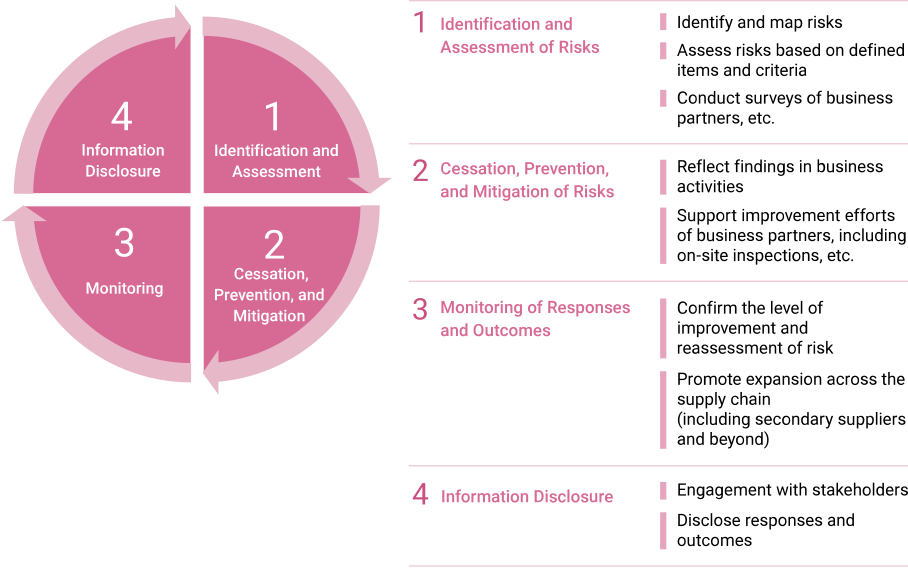
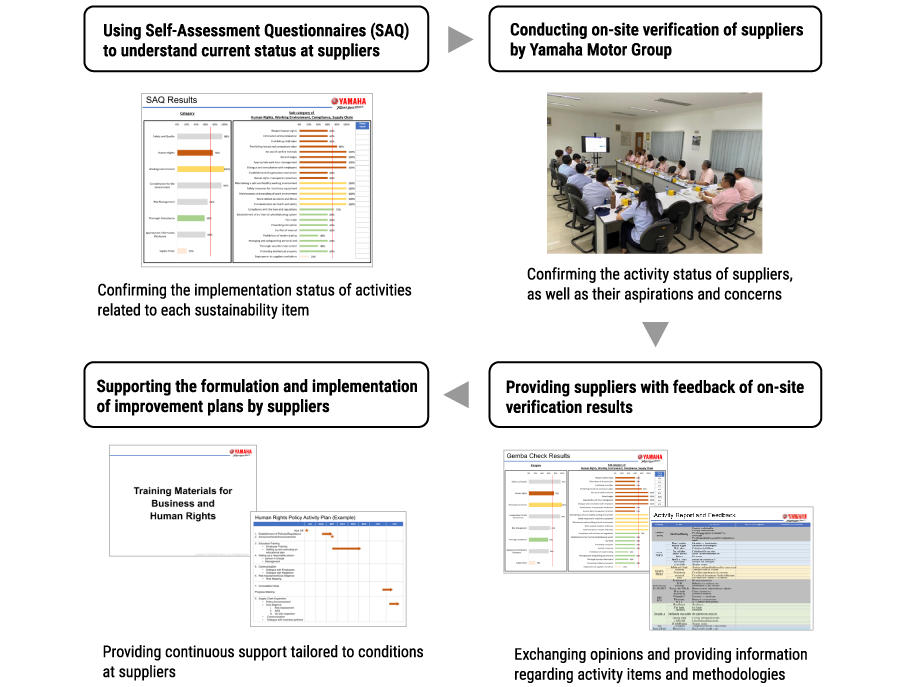
In conducting human rights due diligence across the supply chain, the Group prioritized direct material suppliers and, by 2025, completed risk assessments covering 100% of them, while collecting and reviewing SAQs from 80%. Through the integration of information from both processes and a comprehensive assessment of the risk environment, approximately 15% of suppliers were identified as operating in high-risk environments. The Group has begun phased worksite verification of these suppliers under a three-year plan.
A distinctive feature of our human rights due diligence is that both all business divisions as well as all group companies domestically and overseas take the lead in promoting it. Personnel responsible for risk management, procurement, sales, and other functions within each organization collaborate to advance initiatives suited to regional characteristics and operational realities. These proactive activities contribute not only to improvements among business partners but also to the enhancement of governance within Yamaha Motor Group. Going forward, the Group will continue to advance human rights due diligence with a support-oriented approach, tailored to the realities of the supply chain.
Identification of Risks
Worksite verifications within the supply chain have shown that while understanding of the importance of sustainability and human rights policies is becoming more widely shared, there are still many cases where the formulation of concrete policies and initiatives tailored to each company’s circumstances, as well as efforts to raise awareness and roll out these initiatives internally and externally, have not yet been sufficiently systematized. In light of these findings, the Group places emphasis on providing improvement support prior to audits and monitoring. It is strengthening its efforts to work alongside suppliers through worksite verifications to promote understanding and drive improvement. These efforts include supporting the development of policies tailored to each company’s level of maturity, providing employee training and awareness-raising activities, and assisting in the formulation of corrective action plans.
The Group recognizes the need to further strengthen initiatives in priority areas going forward. In particular, issues related to foreign workers and migrant workers, including technical interns, are increasingly recognized as a matter of importance both in Japan and overseas, and companies receiving such workers are expected to implement appropriate measures and support systems. The Group will increase the effectiveness of initiatives by identifying risks commonly faced by these workers, improving working environments, and ensuring access to information.
With regard to human rights and environmental risks in raw material procurement, exemplified by conflict minerals, the Group recognizes the need to strengthen risk identification and control structures from the broader perspective of responsible procurement, rather than addressing such issues as isolated themes. Through collaboration with suppliers, the Group aims to enhance transparency in procurement processes, implement risk mitigation measures, and build a sustainable procurement framework.
These issues are indispensable to fulfilling the Group’s social responsibilities, and the Group will continue pursuing ongoing improvements while appropriately incorporating them into future activity plans.
Correction and Relief
The Group has established a Compliance Hotline for Group employees, creating a system that enables the prompt reporting of violations of laws, regulations, or internal rules, including human rights violations. Furthermore, the Group has established a Human Rights Hotline for external stakeholders. In addressing reports received hrugh this hotline, the Group seeks to emphasize dialogue with both the reporting parties and the subject(s) of the report (perpetrator) throughout the entire process, from assessing whether a matter constitutes a human rights issue and conducting investigations to considering and implementing corrective actions and measures to prevent recurrence.
In 2025, the Group received reports from external stakeholders and engaged in dialogue with the reporting parties. The Group will continue these efforts and work to ensure that reports lead to meaningful corrective actions and organizational learning.
Human Rights Hotline for External Stakeholders
Reports to the Human Rights Hotline from our external stakeholders are accepted via the web form on this website.
ELIGIBLE MATTERS
Human Rights Hotline accepts matters in which the business activities of Yamaha Motor Group or those of our business partners associated with our group's business activities have caused systematic and substantive negative impacts (harms) on human rights in violation of international principles or national laws on human rights (e.g., forced labor, child labor, systematic or collective discrimination, significant lack of occupational health and safety, negative impacts due to environmental pollution), or matters in which there is concern that systematic and substantive negative impacts (harms) on human rights may occur.
Human Rights Hotline does not accept matters that are not related to human rights stipulated in international principles or national laws on human rights, such as individual complaints about human relations or discretionary acts of personnel management in the workplace, or complaints regarding the quality of the Yamaha Motor Group's products or services.
ELIGIBLE USERS
The eligible users are those who have suffered negative impacts (harms) on their human rights, and those who belong to the same organization, entities, etc. as the person who has suffered negative impacts (harms) on their human rights.
PLEASE READ CAREFULLY BEFORE REPORTING
- Response to the matters reported anonymously may be limited.
- We respond to reports that meet the Eligible Matters, the Eligible Users, and other instructions in the report form. Nevertheless, the reports meeting said criteria may not be responded, depending on the nature of the matters.
- Contents of the report and the submitted materials will be used by Yamaha Motor Group or our external agents, service providers, or business partners to the extent necessary for responding to the matters, including investigation and taking corrective and remedial measures.
- We may disclose or publish a summary of the operation of this Human Rights Hotline.
- Human Rights Hotline is not available for Yamaha Motor Group employees and other internal stakeholders.
- You may report either in Japanese or English.
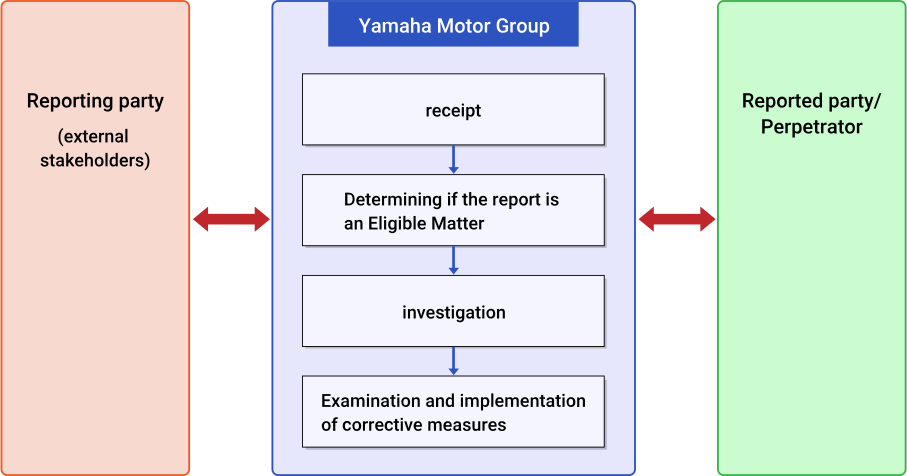
※The above is a standard handling flow, and the actual flow may vary depending on the case.
Supply Chain Rollout
The Group also requires its business partners to understand and comply with its Sustainability Basic Policy and Human Rights Policy. In addition, the Sustainability Guidelines for Suppliers stipulates requirements related not only to human rights and labor environments, but also to environmental considerations and strict compliance, promoting implementation of the Guideline among suppliers. In particular, the Guidelines clearly specify items to be observed in in relation to respect for human rights, including the elimination of discrimination, prohibition of child labor and forced labor, payment of appropriate wages, non-use of conflict minerals, and establishment of grievance mechanisms.
To enhance the effectiveness of its Human Rights Policy, the Group has been incorporating provisions related to human rights into transaction contractual agreements and confirming compliance with the Guidelines. Through these efforts, the Group achieved its target of 80% among all supplier partners as of December 31, 2024. As a next target, the Group aims to achieve 100% by December 31, 2027.
Through its human rights due diligence framework, the Group supports suppliers in formulating and deploying human rights policies and continues providing support to enhance suppliers’ capabilities to address human rights risks.
The Group will continue promoting the dissemination and implementation of policies throughout its entire supply chain, including business partners, and remain committed to respecting human rights toward the realization of a society in which the dignity of all people is protected.
Preventing Harassment
In light of the rapidly growing need to address and adapt to human rights risks throughout the supply chain, the Yamaha Motor Group has stipulated in its Code of Ethics that it forbids slander against employees concerning matters pertaining to their race, nationality, philosophy of life, bodies, personality, families, etc., forbids words and actions that deny an individual’s personhood, and also forbids sexual harassment and all other actions that constitute harassment. However, anyone can become a perpetrator of harassment without intending to, and once serious incidents of harassment occur, they have the potential to affect not only the victims but also the Company, the organization and even our business activities themselves.
Therefore, we endeavor to foster an organizational culture that makes it hard for harassment to occur through initiatives such as spreading the diversity, equity and inclusion (DE&I) the Group is engaged in and increasing employee engagement. When an incident does occur, we handle it speedily and appropriately, including working to prevent a recurrence, and we continue to raise awareness and undertake educational activities to prevent harassment from ever occurring.
Moreover, in addition to the existing compliance incident reporting contact points for Japan, in 2023 we added new consultation points dedicated to harassment and labor issues, and we created a reporting line to allow people who suffered or heard or saw harassment to consult someone promptly on the issue. When we receive a report of harassment, we conduct a hearing with the persons concerned to confirm the situation, after which we take appropriate ways such as disciplinary actions or instructions, and take measures to prevent a recurrence.

