
Initiatives for "Resource Recycling"
Yamaha Motor works on solution to issue of resource recycling through its business activities.
The Yamaha Motor Group set “promoting recycling and the effective use of limited resources” as a goal and has undertaken various initiatives to create a circular economy.
Going forward, we will continue to adopt various approaches to conserve natural resources and enhance recycling efficiency. In addition to actively utilizing recyclable materials, we are reducing the number of parts and making them smaller by pursuing optimal size. We also use LED technologies to lengthen product life while adopting design for disassembly and improving the recyclability of parts.

Vision for Resource Recycling

The Group seeks to promoting recycling and the effective use of limited resources.
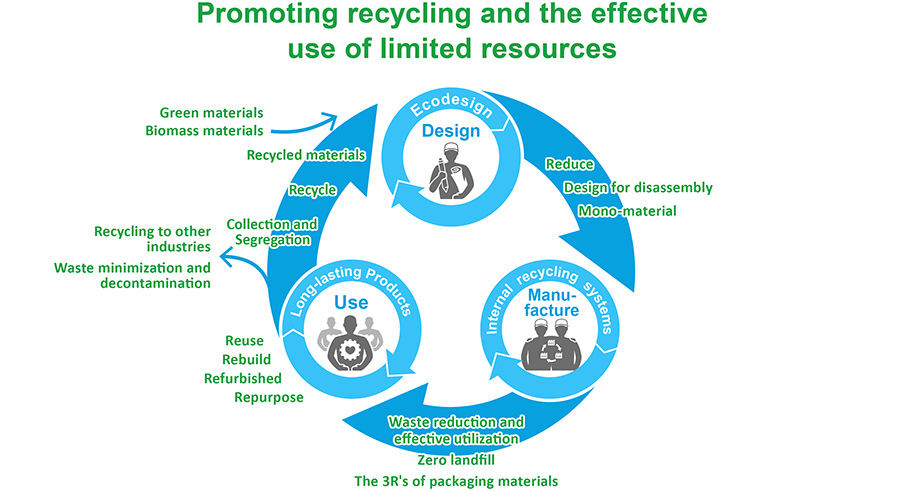
By connecting the circulation of the three phases of “design,” “manufacture,” and “use,” the Group seeks to maximize the value of limited resources.
- Design:
- Design sustainable materials*1. The Group will enhance eco design, including reducing the amount of materials used, designing for disassembly, and monomaterialization.
- Manufacture:
- Through the Group-wide application of technologies for effective resource usage, including in-process and inter-business recycling, the Group aims to minimize waste and maximize resource value.
- Use:
- The Group promotes initiatives that enable products to be used carefully over long periods, including reuse, rebuild, refurbish, and repurpose initiatives.
The Group will continue advancing its unique resource recycling model throughout the entire product lifecycle by leveraging the characteristics of being a multi-product Group with a diverse product portfolio.
*1: “Sustainable materials” is a general term that includes recycled materials, green materials (such as those produced using renewable energy), and biomass materials
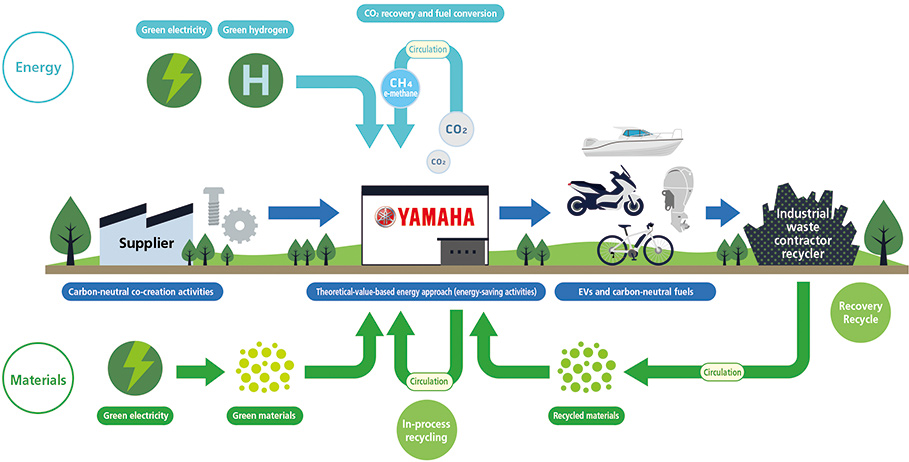
Reduction of New Resource Use through the Use of Renewable Resources

― Shift to Sustainable Materials Centered on Recycled Materials
To ensure the sustainable use of resources in the future, we are promoting resource recycling initiatives.
In particular, we believe it is necessary to promote the 3Rs of materials, the adoption of materials with low CO2 emissions during production and the use of natural material–based resources.
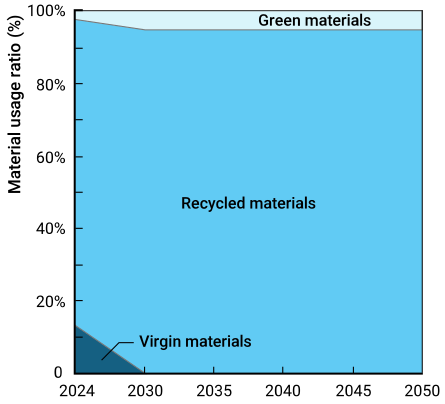
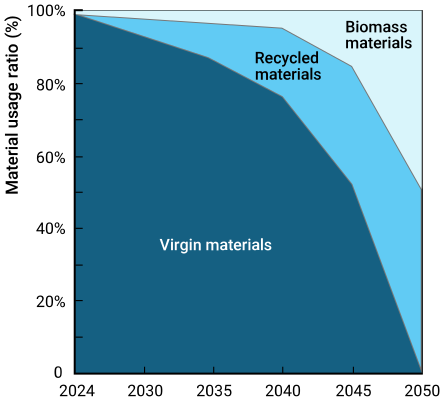
We have now established medium- to long-term targets related to resource recycling and set a goal of switching 100% of materials used in our products to sustainable materials by 2050.
As a basic policy, we will promote the shift to materials that are easy to recycle after use, assuming the use of market-based systems for product recycling.
① Aluminum alloy initiatives
As of now, 85% of the aluminum alloy used for in-house production has already been switched to recycled materials and 5% to green materials.
The remaining virgin materials are used for components that require high functionality and strength, making it difficult to switch to recycled materials up to this point.
For cast aluminum alloys, we are working on the development of recycled materials that satisfy equivalent functionality and strength to virgin materials and plan to proceed with the switch going forward.
In addition, for rolled materials currently using virgin aluminum, we have partially adopted green materials smelted using renewable energy since 2023 and plan to expand the volume used. Through these efforts, we plan to switch 100% of aluminum alloy used for in-house production to sustainable materials by 2030.
② Use of electric furnace steel sheets for packaging steel frames
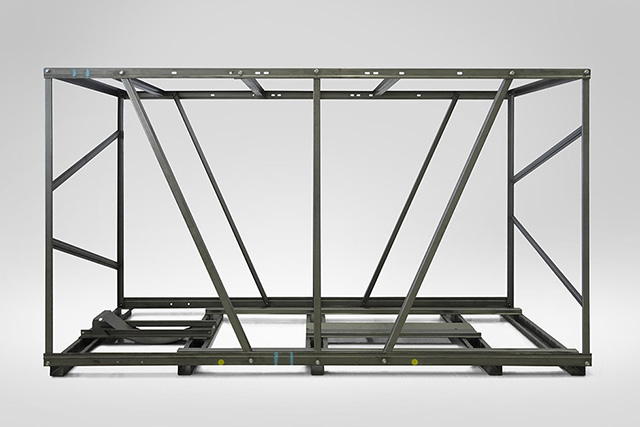
Yamaha Motor has become the first company in Japan*1 to begin applying low-carbon, circular steel—electric furnace steel sheets—as the raw material for the packaging frames used in motorcycle product shipments. We are gradually expanding the scope of their application.
Electric furnace steel sheets are a type of recycled material manufactured by melting iron scrap such as that from building demolition, discarded home appliances, and end-of-life vehicles in an electric furnace and then rolling it. Compared with conventional blast furnace steel made using iron ore and coke, electric furnace steel significantly reduces CO2 emissions during production.
In collaboration with Tokyo Steel Manufacturing Co., Ltd., we verified the performance and quality of electric furnace steel sheets for use in packaging frames and began applying them to motorcycle packaging frames starting with October 2024 shipments. We plan to gradually expand the scope of application to increase the use ratio of recycled materials in packaging frames.
In line with the “Yamaha Motor Group Environmental Plan 2050,” which aims to achieve carbon neutrality across the entire supply chain, including business activities, by 2050, we are promoting the adoption of green materials and expanding the use of recycled materials toward the shift to 100% sustainable materials.
*1 Yamaha Motor internal research (July 2024)
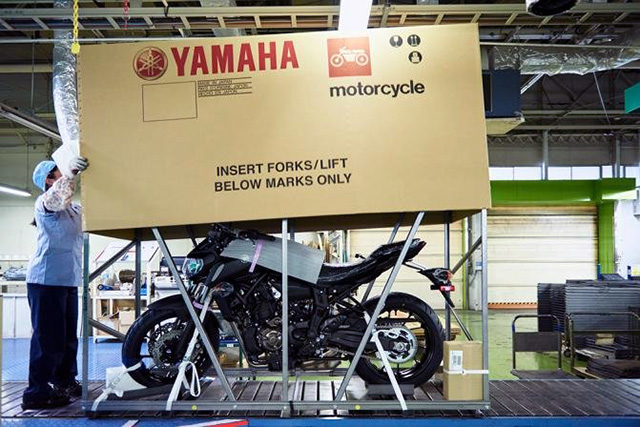
Yamaha Motor First in Japan to Adopt Low-Carbon Recycled Steel for Motorcycle Packaging Frames -- Expanding the scope of use for steel sheets produced by electric furnaces to progress toward our goal of carbon neutrality with raw materials -- | News
③ Initiatives for general-purpose plastics and engineering plastics
The plastics used in in-house manufacturing include general-purpose plastics such as PP and ABS, as well as engineering plastics such as PA.
At present, PIR materials*2 have been adopted for a portion of the Group’s PP general-purpose plastics, and development is underway to expand the scope of application. For ABS, the Group is considering replacement with recycled ABS and the adoption of materials with lower CO2 emissions. For engineering plastics that require high strength, it is first necessary to verify the feasibility of developing recycled materials.
Securing supply in the future has been identified as a challenge in the recycled plastics market. With this in mind, the Group plans to promote alternatives to virgin materials by securing recycled materials including PIR and PCR*3, including the use of biomass materials.
*2 Post Industrial Recycled (recycling of industrial-origin plastics)
*3 Post Consumer Recycled (recycling of consumer-origin plastics)
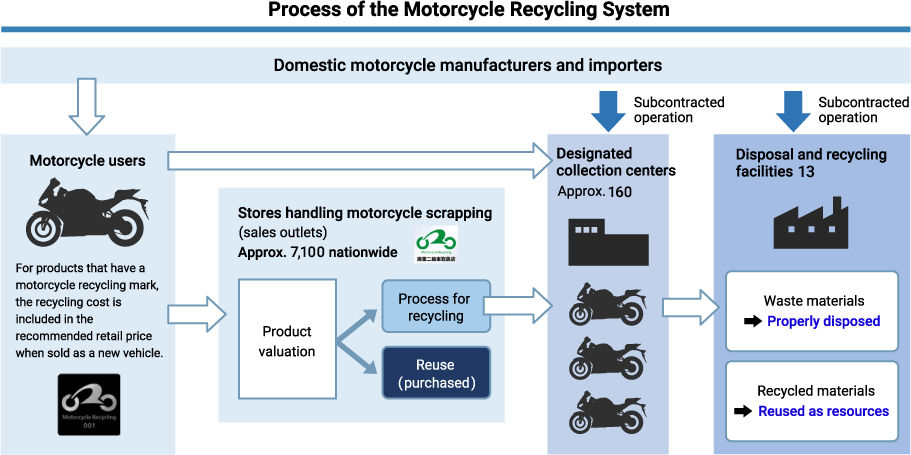
Motorcycle Recycling System
The motorcycle recycling system in Japan is a voluntary initiative to promote the appropriate disposal of scrapped motorcycles and the recycling and reuse of resources and to achieve a recycling-oriented society. In 2024, the recycling rate was 97.8%. Along with promoting the use of the motorcycle recycling system, the Yamaha Motor Group takes responsibility for the appropriate disposal and recycling of Yamaha end-of-life motorcycles that customers wish to scrap.
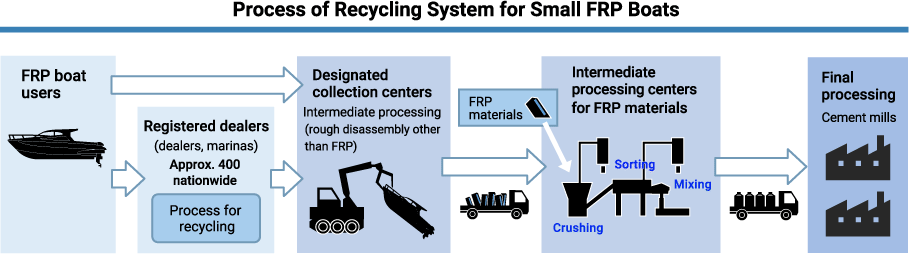
Recycling System for Small FRP Boats
The recycling system for small boats (boats, yachts, personal watercraft, fishing boats, etc.) made from glass fiber-reinforced plastic (FRP) is mainly carried out by the Japan Marine Industry Association's FRP Boat Recycling Center. After scrapped FRP boats are taken to subcontracted, designated collection centers and roughly disassembled, FRP materials are taken to an intermediate processing center where they are crushed and sorted, and finally calcined to cement for recycling (material thermal recycling).
Yamaha Motor participates in this recycling system, and takes responsibility for appropriately disposing of and recycling FRP boats that customers wish to scrap and have recycled.
Measures to Reduce Waste and Conserve Resources at the Manufacturing Stage
Yamaha Motor separates metal, plastic, foundry sand, and other waste for recycling as raw materials. We also subject oil and some plastics to a thermal recycling process to create materials that can be used as combustion improvers. In addition, we use post-combustion residue as a raw material in cement and roadbeds. As a result, we have maintained our direct and indirect landfill record of “zero tons” (a 100% recycling rate). In 2025, Yamaha Motor generated 12,004 tons of waste. It also generated 1,409 tons of industrial waste from plastic-using products.
| 2021 | 2022 | 2023 | 2024 | 2025 | |
|---|---|---|---|---|---|
| Waste Generated | 13,516 | 14,173 | 15,514 | 13,602 | 12,004 |
| Emissions*1 | 21,520 | 24,282 | 24,451 | 20,922 | 20,427 |
| Specially controlled industrial waste*2 | 178 | 198 | 404 | 1,308 | 390 |

*1 Aggregate volume of materials discharged (including industrial waste, specially controlled industrial waste and materials with value)
*2 Industrial waste materials that are explosive, poisonous, infectious, or otherwise harmful or potentially harmful to human health or the environment
The Yamaha Motor Group has been working to reduce its volumes of waste by thoroughly separating waste, introducing returnable packing materials, and using longer-lasting cutting fluids and oils. The Yamaha Motor Group generated 59,540 tonsExternal Assurance of waste in 2025.
| 2021 | 2022 | 2023 | 2024 | 2025 | |
|---|---|---|---|---|---|
| a) Recycled/reused waste | 32,693 | 46,328 | 36,517 | 43,641 | 43,441 |
| b) Waste disposed of | 16,864 | 17,897 | 27,103 | 18,621 | 16,058 |
| - Of b), amount of waste disposed of by landfill | 8,666 | 10,496 | 15,233 | 10,581 | 10,152 |
| Data coverage rate of environmental consolidation companies (%) | 100 (134 companies) |
100 (138 companies) |
100 (149 companies) |
100 (146 companies) |
100 (140 companies) |
| Total waste generated (a+b) | 49,557 | 64,224 | 63,620 | 62,263 | 59,540External Assurance |
Scope: Major facilities of Yamaha Motor and its 139 consolidated subsidiaries
The scope has been changed to include Yamaha Motor and its 139 consolidated subsidiaries, effective in 2025, to align with the consolidated financial statements.
Furthermore, since the impact of this revision on prior years is minimal, no retroactive adjustments were made to prior-year data.
In principle, figures are rounded off to the nearest whole number. Therefore, the total does not necessarily match the sum of each item.
Measuring and Reducing Water Consumption
The Yamaha Motor Group is working to reduce consumption of water. In accordance with our 2050 goal of "reducing water usage in production activities," we continue to strive to measure our global use of water and reduce consumption Groupwide through programs including the reuse of coolant water and water collection (rainwater and other sources) at factories, the reuse of water using reverse osmosis (RO) membranes, posters to remind employees to conserve water, and the installation of water-saving packing in faucets.
In 2025 Yamaha Motor's water intake volume was 1,121 thousand m3 and wastewater volume was 1,058 thousand m3External Assurance.
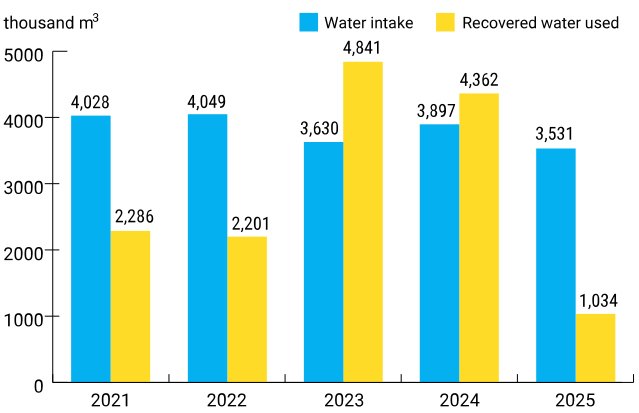
| 2021 | 2022 | 2023 | 2024 | 2025 | |
|---|---|---|---|---|---|
| Underground water | 1,615 | 1,576 | 1,536 | 1,503 | 1,510 |
| Industrial water | 859 | 946 | 583 | 779 | 761 |
| Tap water | 1,226 | 1,228 | 1,396 | 1,569 | 1,257 |
| Other fresh water | 328 | 300 | 115 | 45 | 4 |
| Total water intake(fresh water) | 4,028 | 4,049 | 3,630 | 3,897 | 3,531 External Assurance |
Note: Breakdown includes estimated figures.
Scope: Major facilities of Yamaha Motor and its 139 consolidated subsidiaries
The scope has been changed to include Yamaha Motor and its 139 consolidated subsidiaries, effective in 2025, to align with the consolidated financial statements.
Furthermore, since the impact of this revision on prior years is minimal, no retroactive adjustments were made to prior-year data.
In principle, figures are rounded off to the nearest whole number. Therefore, the total does not necessarily match the sum of each item.

