
Environmental Management
Introducing information concerning environmental management activities
 Contents
- Yamaha Motor Group EHS Management Policy
- Promotion Structure
- Environmental Consolidated Boundary
- Strengthening Environmental Governance through Global Environmental ISO 14001 Unified Certification
- Global Yamaha Motor EHS & Sustainability Communication System
- Integrated Management System Operation
- Life Cycle Assessment
- Strengthening Compliance with Environmental Laws and Regulations
- Green Procurement Guidelines
- Contributing to Reduction of Air Pollution in Each Country and Region
- Reduction of VOC Emission through Production Activities
- Promotion of Environmental Activities in Collaboration with Suppliers
- Raising Environmental Awareness of Employees
Yamaha Motor Group EHS Management Policy
(Environment, Health & Safety, Disaster prevention)
Fulfilling social responsibilities globally" is one of Yamaha Motor Group's management principles. To achieve this, we haveestablished Yamaha Motor Group EHS Management Policy under Yamaha Motor Group Sustainability Basic Policy andOccupational Safety and Health Basic Policy. We, as a united Group, promote E: Environmental conservation, H/S:Prevention of occupational accidents and health problems, and Disaster prevention initiatives.
Regarding the environment, we endeavor to minimize environment issues, including those concerning climate change and biodiversity, in all areas of our business activities. To achieve that, we have set targets for reducing our environmental impact, which we continuously work on, manage and improve. At the same time, we also focus on training and education about lowering our environmental impact.
Promotion Structure
The Yamaha Motor Group has established an Environment Committee, as the central organization responsible for the Group’s environmental activities in Japan and overseas. The committee deliberates on policies and visions for the future concerning environmental initiatives, medium- and long-term environmental policies, strategic investment proposals relating to environmental preservation, environmental monitoring topics and responses to issues, and other key issues relating to environment. The policies and activities discussed are reported to the Sustainability Committee as necessary.
Environmental Consolidated Boundary
The scope covers major facilities of Yamaha Motor and its 139 consolidated subsidiaries that are deemed important for environmental management. (as of December 31, 2025).
Enhancement and Promotion of Integrated Management
Strengthening Environmental Governance through Global Environmental ISO 14001 Unified Certification
Under the Yamaha Motor Group's Basic Sustainability Policy's approach to Global Environment, we have established a globally unified environmental management system (hereafter, Group Environmental MS). We are promoting the acquisition of ISO14001 certification, centering on our manufacturing companies in regions such as Japan, Asia, Europe, and North and South America. In this and other ways, we are undertaking the ongoing increase of our environmental activity levels for the Group as whole.
Under our Group Environmental Management System (MS), the top management of each Group company carries out, as part of their responsibilities, the clarification of roles and authorities related to the Environmental MS, the establishment of implementation frameworks, the monitoring of whether the company’s environmental activities are being appropriately carried out, and management reviews. Through these activities, we provide necessary instructions and corrective actions, and promote highly effective environmental management activities. Furthermore, by compiling the results of the management reviews of each company and implementing reviews of the President and Chief Executive Officer of Yamaha Motor in relation to the management of the whole Group, we are working to ensure the strengthening of the Group’s global environmental governance.
Each Group company gives the highest priority to compliance, obtaining an understanding of stakeholder needs, and determining major risks based on the evaluation of the risks and opportunities related to environmental activities. In addition, we work to reduce environmental risks and prevent pollution, while verifying the conformity and effectiveness of the system through internal environmental audits and promoting its continual improvement.
Global Yamaha Motor EHS & Sustainability Communication System
The Yamaha Motor Group operates its proprietary global information sharing system, "G-YECOS*," to integrally manage and utilize information related to environment and occupational safety and health (EHS) fields and sustainability.
Through G-YECOS, the Group deploys environmental and safety policies, shares the status of initiatives at each Group company, and collects and analyzes data and related indicators concerning environmental incidents, occupational accidents, and fire occurrences. Through these efforts, we improve the effectiveness and operational efficiency of the overall EHS management system. G-YECOS also promotes two-way communication among Group companies and also serves as an ESG data platform with future stakeholder disclosure in mind.
Going forward, the Group will continue strengthening the functions and promoting the utilization of G-YECOS as a common Group portal for EHS and sustainability information.
* G‑YECOS:Global Yamaha Motor EHS & Sustainability Communication System
Integrated Management System Operation
Yamaha Motor has introduced an integrated management system that operates environmental and safety management systems as a whole. This has led to improvement and greater efficiency in on-site business processes. We are also working to improve the effectiveness of the management system through continual improvement using the PDCA cycle.
Meanwhile, integrated management system audits use a proprietary training system led by internally certified auditors to increase the skills of employees in a systematic manner, taking a process-orientated approach to auditing. In addition to helping improve on-site operations through this training, we are also reinforcing governance by setting priority audit items each year and applying them Group-wide.
Life Cycle Assessment
| Business Activities | Initiatives for Reducing Environmental Burden | Impact on Global Warming(CO2 Emissions) |
|---|---|---|
R&D |
Development phase |
Scope 3 |
Procurement |
Procurement phase |
Scope 3 |
Production |
Production phase |
Scope 1 |
Distribution/sales |
Distribution phase |
Scope 3 |
Use |
Use phase |
Scope 3 |
Collection/recycling |
Disposal phase |
Scope 3 |
Strengthening Compliance with Environmental Laws and Regulations
In recent years, there has been a sharp increase in regulated substances due to strengthened regulations on chemical substances contained in products in various countries. In addition, particularly in Europe, there has been expansion, enactment, and drafting of laws related to climate change, resource recycling, and biodiversity. Compliance with these environmental laws and regulations has extended across the entire supply chain and product lifecycle, becoming an extremely important issue in corporate management. Yamaha Motor has established the Product Environmental Regulation Committee, which is responsible for building systems and frameworks to address these expanding regulatory requirements, formulating response policies for regulations in each country, promoting initiatives, and confirming the status of compliance, thereby implementing the PDCA cycle. Furthermore, the Company is steadily expanding these activities not only in Japan but also to overseas Group companies. We are also emphasizing employee education, including providing e-learning programs for all employees and specialized training for relevant personnel.
Green Procurement Guidelines
The Yamaha Motor Group is working with suppliers to control and reduce environmentally hazardous substances and make more efficient use of natural resources and energy in accordance with its Green Procurement Guidelines.
Contributing to Reduction of Air Pollution in Each Country and Region
Yamaha Motor controls the emission of environmentally hazardous substances from its factories according to laws and ordinances. We strive to reduce the emission of such substances through various efforts, including optimization of equipment operation conditions to reduce NOx generation, improvement of thermal efficiency to reduce fuel usage, and replacing existing fuels with low-nitrogen, low-sulfur alternatives.
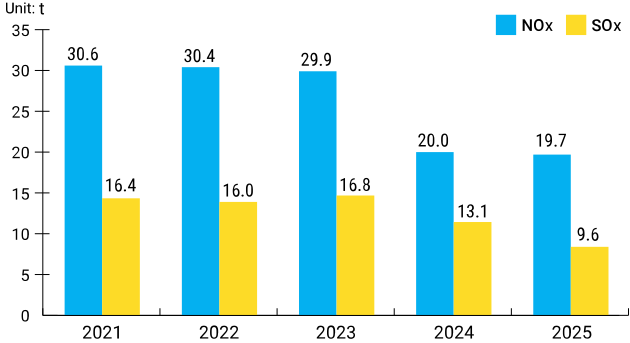
NOX :Nitrogen Oxides SOX :Sulfur Oxides
Reduction of VOC Emission through Production Activities
The Yamaha Motor Group monitors and reports emissions of chemical substances harmful to humans and the environment and amounts of such substances contained in waste according to the regulations of each country. Over 99% of substances subject to reporting under the Pollutant Release and Transfer Register (PRTR) scheme that Yamaha Motor releases into the environment are volatile organic compounds (VOCs), and most of them are used in painting operations.
The Yamaha Motor Group will continue to promote efforts to increase the use of paints with minimal VOC content, improve coating efficiency, and reduce paint wastes. In FY2025, the per unit emissions volume per area painted was 108g/m2, and we achieved our target.
FY2025 target: 110g/m2 or less per unit
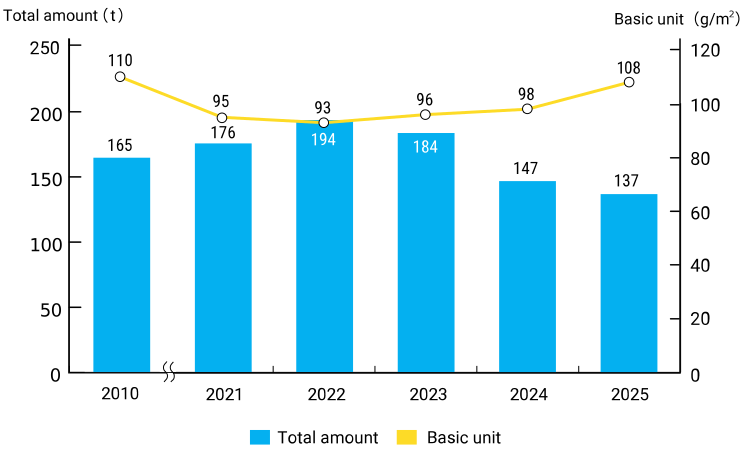
VOC :Volatile Organic Compounds
Promotion of Environmental Activities in Collaboration with Suppliers
Since 2019, our environmental facility division and procurement division have been working together to help suppliers promote environmental activities. Specifically, they select companies deemed to have high environmental impact from a list of suppliers in Japan and abroad. Then the environmental facility division measures their power usage, identifies the amounts of power loss, and provides advice and know-how based on its findings. The suppliers initiate activities based on the input and introduce the same improvements at the rest of their factories. Going forward, we will further pursue these activities as a Groupwide effort including suppliers, with different suppliers targeted each year.
Since 2023, at events with our major suppliers in various countries, we have been explaining the status of our carbon neutrality initiatives such as those concerning raw materials and energy conservation, and shared our approach and direction.
Raising Environmental Awareness of Employees
Introduced Yamaha Eco Point System
In January 2008, Yamaha Motor introduced its Yamaha Eco Point System targeting employees. This system assigns points to environmental activities including participation in eco-commuting and cleanup programs, and allows members to select eco prizes according to the number of activities conducted and the number of points earned during the year.
Using the Intranet to Foster an "Eco Mind"
Yamaha Motor uses its corporate intranet to report in a timely manner on the status of eco-commuting and employee volunteerism and to disseminate information on cleanup programs for beaches and areas in the vicinity of Company facilities as well as environmental communication with local communities and the public. These efforts serve to raise employee awareness concerning the environment and to encourage participation.
Distribution of ESG-related Information by Email
Since January 2019, we have been sending a monthly email to employees at Yamaha Motor and Group companies in Japan, containing ESG-related information including environmental information.
The articles contained in these emails are also posted to our intranet so they can be accessed at overseas Group companies.
Articles to date have included explanations of the external environment affecting environmental issues and the Yamaha Motor Group Environmental Plan 2050.

