
Existing Core Competencies
Trace the steps of how our technology has created value for mobility and people’s lives

The origin of Yamaha Motor’s technologies can be traced down to a single engine.
Our powertrain expertise—which has gone on to serve as the basis for all sorts of Monozukuri pursuits—began with the 2-stroke engine in the YA-1 the company offered at its inception.
Since then, we have kept our finger on the pulse of people’s lifestyles as it expanded to 4-stroke engines and electric motors while expanding their fields of use with consistent improvements.

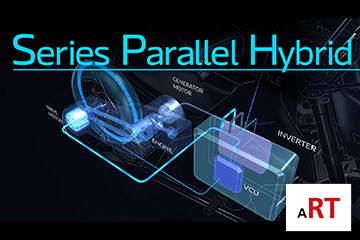
- A New Challenge in Electric Technology
—The Series Parallel Hybrid System - Yamaha Motor is making inroads into EV. The first step in this approach is the Series Parallel Hybrid designed for use in mid-size scooters.
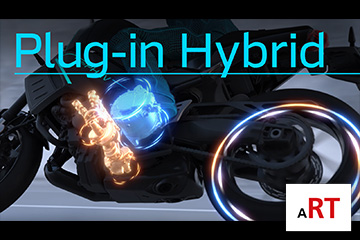
- A New Challenge in Electric Technology
—The Plug-in Hybrid System - Here is the second in our series of Yamaha-style EVs with a plug-in hybrid system designed for use in our large motorcycles.
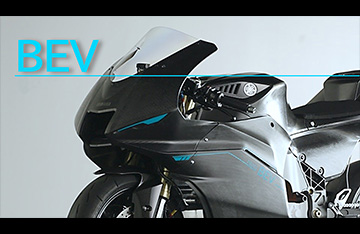
- A New Challenge in Electric Technology
—The Battery Electric Vehicle - The third entry in our series of uniquely Yamaha EVs envisions a battery-powered supersport motorcycles.
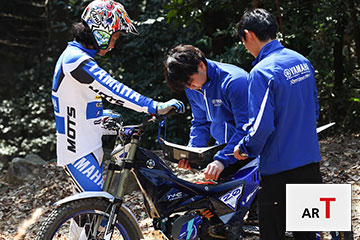
- Cutting-Edge Development via Racing: An Electric Trials Bike
- The main hurdles to making electric mobility more widespread are range, power and torque characteristics, weight reduction, and affordability. See how Yamaha Motor is conducting R&D and testing an electric trials bike through competition (released June 2023).
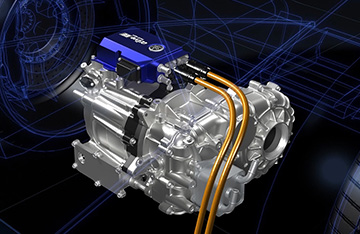
- e-Axle: An Electric Motor Unit for Hyper-EVs

- This compact electric motor was developed for hyper-EVs, anticipating the installation of four or more units on one vehicle, and treats the mechanical and electrical components as a single entity, integrating the gear and inverter into one unit.
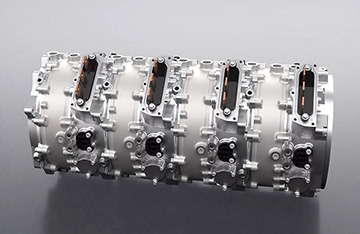
- Connectable Electric Motors for Aviation, Marine, and Other Mobility Applications
- In anticipation of use in hybrid aircraft and electric vessels like tugboats, this electric motor is designed to allow multiple units to be connected in series. A single unit achieves a rated output of 500 kW, with a quad-motor configuration delivering an incredible 2 MW in output.
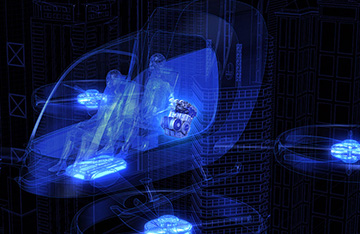
- Range Extenders for Drones
- This powertrain expands the range of applicability (operating time, payload, etc.) for using electric power with mobility products by partially replacing the energy supplied by the batteries in an EV.
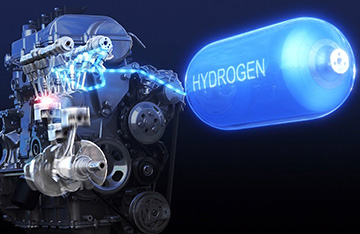
- Engines Burning Hydrogen for Zero CO2 Emissions
- Using existing internal combustion engines, the fuel lines, injectors, spark plugs, etc., are all optimized for combusting hydrogen. There are expectations for these powertrains to not only help spread hydrogen-related infrastructure but also contribute from an industry sustainability perspective by finding new applications for its vast store of technologies.
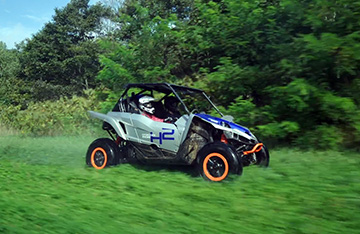
- A Hydrogen-Powered ROV
- This off-road recreational vehicle keeps the unique joys of internal combustion engines relevant for the future. Yamaha collaborated with Lexus to conduct experiential programs and test drives for general customers on a dedicated off-road course. Development of the vehicle's fail-safes is also currently underway (as of 2025).
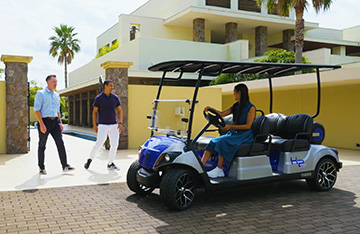
- A Hydrogen-Powered Golf Car
- Golf cars are now no longer only for getting around golf courses. In North America, they are also used as low-speed vehicles along dedicated routes/lanes in residential areas. A Yamaha golf car with a hydrogen engine (announced Jan. 2024) offers a third powertrain option alongside the traditional engine and all-electric versions.
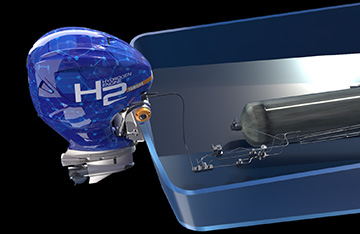
- Hydrogen Outboard Motor
- Whether it is energy efficiency or cruising range, electrification in the marine industry presents high technical hurdles to clear. This outboard explores a different way to carbon neutrality on the water. Developed together with North American boatbuilder Regulator Marine, the outboard is fitted to a dedicated boat with three hydrogen tanks installed in the hull and is currently undergoing real-world testing (announced Nov. 2024).

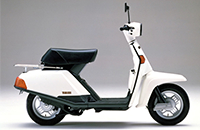
- Easy-to-Use CVT-equipped Engines

- An Engine Design Enabling Reduced Loss and Compact Size
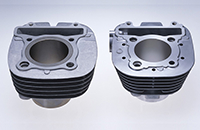
- The Result of Aluminum Research: The DiASil Cylinder
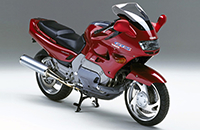
- Electronically-Controlled Fuel Injection

- “2-Strokes” to Handle Any Job, Anywhere
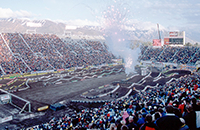
- The Pioneering “4-Stroke”

- Smooth Torque Refined in the Desert

- Electronically-Controlled Throttle
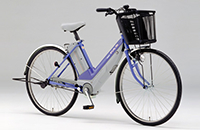
- The Waza: Combining Human Power and Electric Power
- The “GREEN CORE” Ideal: An Accumulation of Yamaha Know-how and Success
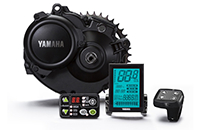
- Two Drive Units Expanding the PAS World
- A Liquid Engine Component
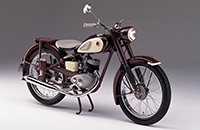
- Yamaha’s First 125cc Engine
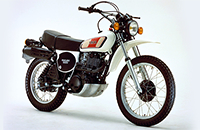
- Forty Years of Admiration for the Big Single
Related Links

Electric motors for use in automobiles and other vehicles
