Motivation for the Next Challenge
Three Generations of MOTOROiD Reveal a New Relationship Between Humans and Mobility

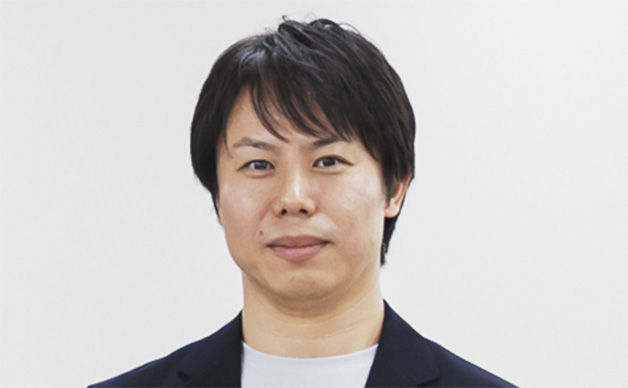
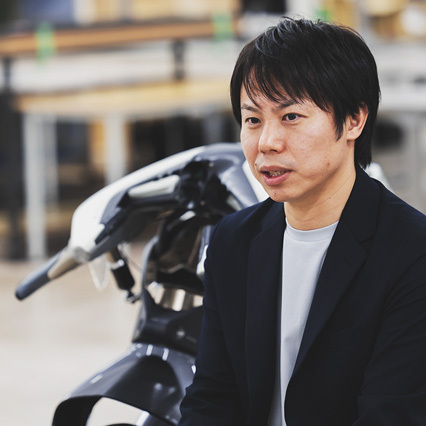
Koji Shinohara
Project Leader, MOTOROiD2
Biomechanics Group,
Human Research Division
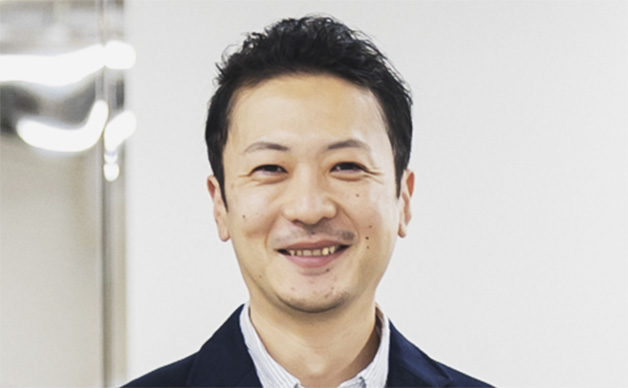
Keisuke Terada
Project Manager, MOTOROiD:Λ
New Business Products 2 Group,
Project Promotion Division
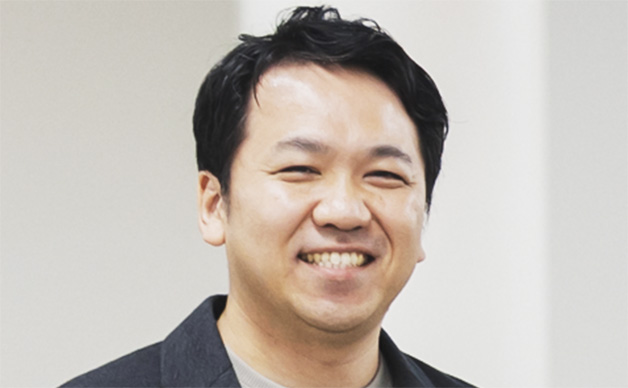
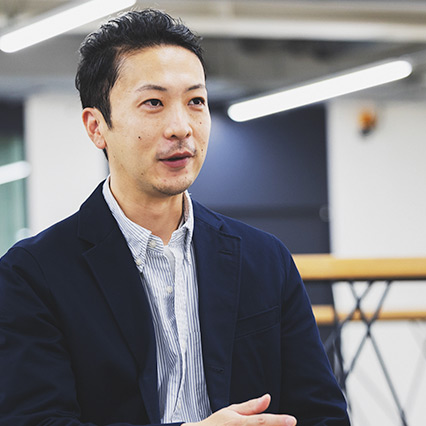
Takayuki Sano
Project Leader, MOTOROiD:Λ
Business support 2 Group,
Project Development Division
MOTOROiD is a form of mobility that learns on its own, stumbles, stands up again, and gradually acquires new capabilities. In that sense, its journey mirrors our own—repeating cycles of trial and error and growth within everyday life. By sensing our intentions, standing beside us through challenges, and encouraging us with the feeling that “maybe next time will work,” it becomes something more than a machine. It feels, instead, like a partner in life — one that quietly supports our motivation to move forward.
Yamaha Motor continues to create MOTOROiD by reexamining the relationship between human and mobility, while applying the technologies it has cultivated together with its Jin-Ki Kanno development developmental ideal.
MOTOROiD is not merely a form of mobility. It is a forward-looking project, created to guide us toward the next challenge ahead.

——Within the history of Yamaha Motor, what role does MOTOROiD play? And what intentions and aspirations were embedded in the original MOTOROiD?
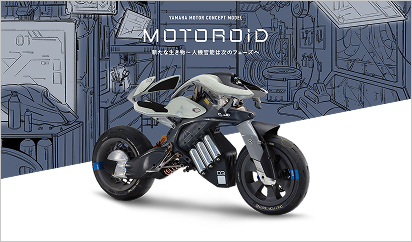
Shinohara: The development of MOTOROiD began with a desire to create future forms of Kando rooted in Yamaha Motor's fundamental development developmental ideal of Jin-Ki Kanno. At the heart of the concept was "unleashed prototype." While exploring what the optimal interface for a future motorcycle could be, the project set out as a form of mobility in which human and machine can become one.
——As the concept evolved from MOTOROiD to MOTOROiD2, and now to the latest MOTOROiD:Λ, did the development concept itself change along the way?
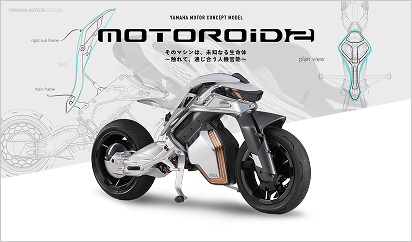
Shinohara: Development of MOTOROiD2 began with a simple question: If the relationship between "a person who gives instructions and a machine that obediently executes them" were to evolve into one of "equal partners," what kind of new Kando experience would emerge? For that reason, in contrast to the mechanical, inorganic presence of the original MOTOROiD, MOTOROiD2 adopts an organic and elegant design. In addition, its control systems were further evolved to support the rider's body according to riding posture and to maintain balance, creating a form of mobility that allows the rider to entrust themselves to the machine and enjoy a deeper sense of unity.
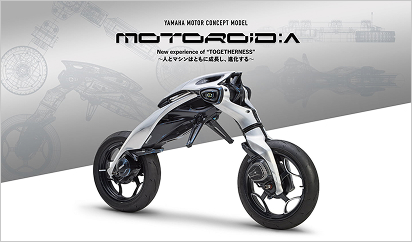
Terada: The concept behind MOTOROiD:Λ (Lambda) is centered on the use of Physical AI, enabling the mobility itself to think, move autonomously, and grow through experience. Development progressed based on the belief that when an independent mobility and a human engage with one another, a new form of Jin-Ki Kanno — Togetherness as a shared relationship —can be created.
Sano: By leveraging AI technology, we are taking on our first challenge of combining AI with vehicle dynamics—aiming to realize autonomous behavior that moves and responds like a living being through an enormous number of simulations of various vehicle motions. Throughout development, we repeatedly ran simulations in a virtual environment, then transferred the AI we had built into the real-world MOTOROiD:Λ, continuing development through real-world testing and iteration. At first, the gap between simulation and reality was significant, requiring constant trial and error. But once a certain threshold is crossed, the machine suddenly becomes able to stand on its own. By repeating this process, MOTOROiD:Λ has grown step by step, and today it is capable of a wide range of movements.


——Through MOTOROiD, how is the core Yamaha Motor developmental ideal of Jin-Ki Kanno — its Oneness (a sense of physical unity) and Togetherness — expressed?
Shinohara: In order to pursue what defines Yamaha Motor, MOTOROiD has been developed with a strong focus on Jin-Ki Kanno, as well as Oneness and Togetherness. The first-generation MOTOROiD was designed to further heighten Oneness — the sense of becoming one with the motorcycle and fully immersing oneself in riding. This approach builds on the technical standards Yamaha has cultivated since its founding, exemplified by the philosophy of "Yamaha Handling" while aiming to optimize both function and structure.
And with MOTOROiD2, the focus shifted to Togetherness — enhancing the emotional and psychological sense of unity between people and mobility, and pursuing the joy of resonating with a machine. To express a deeper emotional relationship with humans, visualized responses using light were introduced, along with communication through movement enabled by AI. In this way, MOTOROiD2 was designed to be a form of mobility that feels like your indispensable companion. As a result, the design allows riders to interact through direct physical contact, enabling subtle and intuitive communication while operating the vehicle with their body supported by the machine.
——With MOTOROiD:Λ, which learns on its own, it feels as though the relationship with people has evolved even further.
Terada: MOTOROiD:Λ is envisioned as a form of mobility capable of building a relationship with its rider much like that between a person and a horse, with the goal of realizing Togetherness with the rider. In other words, it is a mobility that can support the rider in accordance with their skill level, even when they take on challenging riding situations — one that can encourage and enable human challenge. For example, by assisting with cornering, a rider may gradually find themselves able to ride in ways they could not before, almost without realizing it. At present, MOTOROiD:Λ is still in the phase of acquiring its fundamental capabilities. But as it continues to grow and mature, we believe that this kind of relationship with people will eventually emerge.
Sano: Looking further ahead, we envision MOTOROiD:Λ learning from a rider's actions by sensing their joy and excitement, and in doing so enabling forms of riding that are even more exhilarating or more comfortable — new experiences that a rider alone might never reach. In other words, MOTOROiD:Λ grows in response to each individual rider, while the rider, supported by MOTOROiD:Λ, is able to grow as well. This relationship—one of a trusted companion and a supportive partner — embodies Togetherness, and ultimately gives form to the developmental ideal of Jin-Ki Kanno.

——That cycle of growth also resonates with Yamaha Motor's Long-Term Vision: a cycle in which New Kando experiences become motivation, leading to the next challenge.
Sano: Exactly. By realizing a cycle in which as MOTOROiD:Λ grows, people are able to take on new challenges as well—continuing to grow together, we hope to build a relationship in which people and mobility can remain closely connected over the long term.
Shinohara: When the machine—unable to stand or even move at all at first—finally rose up on its own after countless failures and became self-supporting, everyone on the team shared the same feeling: "It did it…" We all celebrated together. That moment, when the growth of MOTOROiD seemed to overlap with the growth of the development team itself, remains deeply etched in my memory.
——At the same time, it also resonates with the philosophy of Yamaha's founder, Genichi Kawakami — the idea of "Striving to enjoy life."
Shinohara: MOTOROiD2 can recognize its owner using an AI camera and approach them, perform supple, emotion-filled movements like a living being, or even walk slowly alongside them. Through these diverse forms of communication, it stays close to people like a companion. In doing so, it becomes a form of mobility that allows humans and machines to enjoy life together, sharing emotions and connecting with one another.
Terada: Looking ahead, MOTOROiD:Λ also aims to sense danger and help the rider avoid it naturally, without discomfort. Through this, the rider can experience the joy of riding, gain motivation for new challenges, and continue to grow.
Shinohara: Looking further ahead, there is also the possibility that MOTOROiD, through the use of AI technologies, will stay close to human emotions and provide support much like a trusted, intuitive friend. That kind of technology, too, I believe, ultimately connects to the act of truly enjoying life.

——From the perspective of the Long-Term Vision, how will future mobility engage with people?
Sano: As a Kando Creating Company, Yamaha Motor places great importance on the Kando experienced by users, and on the relationship between humans and mobility. That is why the direction MOTOROiD:Λ aims for is not a world of "fully autonomous driving," but a world where humans and mobility enjoy experiences together. For example, we envision a future where those who have been interested in motorcycles but hesitated to take the first step can feel at ease and move forward with confidence, supported by MOTOROiD:Λ.
——Finally, could you tell us what motivates you, as developers, to continue your research?
Sano: For me, it's simply that research and development itself is fun — and that enjoyment directly fuels my motivation. Until now, control development has followed an approach where humans design the logic and then implement it into mobility. But MOTOROiD:Λ, which thinks and grows on its own, can arrive at answers that truly go beyond human imagination. That's what makes it so fascinating, and what gives me a strong sense of new possibilities.
Terada: The pace of progress in the AI field is incredibly fast right now. We need to keep up with that speed while carefully deciding what we want the mobility itself to think about, and how those ideas are embedded into its learning. At the same time, in order for the machine to move naturally—maintaining balance and a sense of unity with people—we must understand human movement and balance more deeply than ever before. For me personally, it may be the future we want to realize that ultimately becomes the motivation behind my research.
Shinohara: The Kando we felt when MOTOROiD succeeded in standing up on its own—something no machine had ever been able to do before—is impossible to fully put into words. It was the moment when our mission as engineers—to create something that does not yet exist in the world—was realized. Driven by the Kando of having brought an envisioned future into reality, we want to continue taking on new challenges and pushing development even further.
Learn more about each generation of MOTOROiD.