
President's Message
Management group message
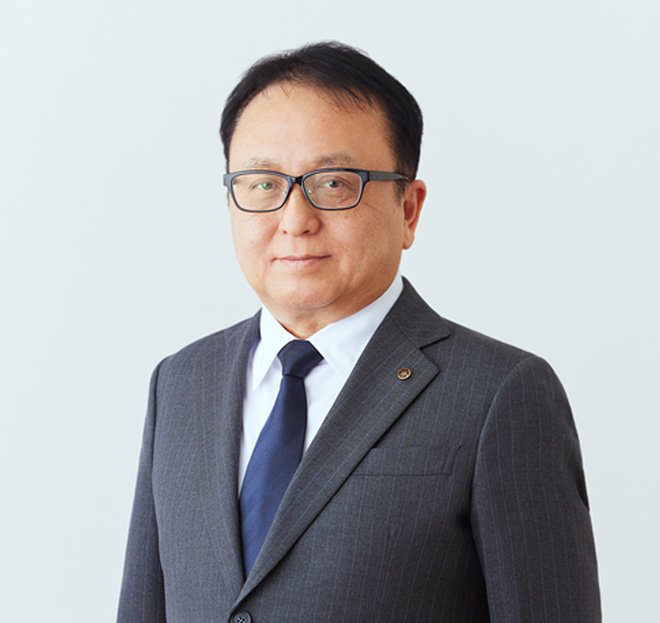
February 2026
Raise the competitiveness of our core businesses, acquire new technologies that expand human possibilities, and take on uniquely Yamaha challenges to create a world where people’s happiness and the environment coexist in harmony.
Yamaha Motor was founded in 1955 as a mobility manufacturer by Genichi Kawakami from his desire to make enjoying daily life commonplace.
Our efforts to do just that led to our subsequent growth as a company through the diversification of the business centered around outdoor recreation, challenging ourselves to push into global markets, creating new demand, and creating new value from a sustainability perspective. Yamaha Motor also celebrates its 70th anniversary this year.
Our Corporate Mission is to be a Kando* Creating Company. In 2018, we announced “ART for Human Possibilities: Let’s strive for greater happiness” as our Long-Term Vision for 2030. New MTP comes at the beginning of the six-year half remaining in our Long-Term Vision. With the basic policy of "Raise the competitiveness of our core businesses, acquire new technologies that expand human possibilities, and take on uniquely Yamaha challenges to create a world where people’s happiness and the environment coexist in harmony", we aim for further growth.
The environment surrounding the Yamaha Motor group in 2025 continued to be one of uncertainty due to the economic policies enacted by various countries, including U.S. tariffs, foreign exchange rate fluctuations, and other factors. Meanwhile, government stimulus measures helped support the global economy, such as lower policy interest rates in the U.S. and Europe.
Demand in our core business of motorcycles remained firm, but demand for the Marine Products business and our strategic businesses—Robotics, Smart Power Vehicle (SPV), and Outdoor Land Vehicle (OLV)—in some markets was lower than expected, resulting in a difficult business environment.
Although unit sales in the motorcycle business went up in Indonesia, the Philippines, and Thailand, the suspension of production and shipments in Vietnam, the decline in personal watercraft unit sales in the Marine Products business, and lower unit sales in the OLV business led to 2,534.2 billion yen (a decrease of 42.0 billion yen or 1.6% compared with the previous fiscal year) in revenue for the consolidated management accounts for the full fiscal year.
As for operating income, the impact of U.S. tariffs; rising procurement costs; increases to R&D spending, labor costs, and other SG&A expenses; and recording impairment losses on tangible fixed assets in the OLV business resulted in an operating income of 126.4 billion yen (a decrease of 55.1 billion yen or 30.4%).
The uncertain environment is expected to remain a fixture in 2026.
Based on our current Medium-Term Management Plan (2025–2027), we will continue to raise the competitiveness of our core businesses and carry out our business portfolio strategy.
Furthermore, we will focus on three key themes in the areas of marketing, technology, and manufacturing/procurement, linking them together to strengthen the entire Yamaha Motor group’s profitability structure. We will swiftly move to rebuild our customer-centric marketing, conduct forward-looking management of our technical resources, and reform our Monozukuri to gain competitive advantages.
As we work toward realizing our Long-Term Vision of “ART for Human Possibilities: Let’s strive for greater happiness,” we will endeavor to deliver Kando to and answer the expectations of all our stakeholders.
I ask for your continued guidance and support as we move forward together.
Motofumi Shitara
President and Representative Director
Yamaha Motor Co., Ltd.
* Kando is a Japanese word for the simultaneous feeling of deep satisfaction and intense excitement that people experience when they encounter something of exceptional value.
