
User's Voice
“It couldn’t have been possible without the CELL HANDLER™”—
Automation That Enables the Isolation of Clones in a 3D Culture
In recent years, research has advanced the use of genome-editing technologies to generate cells with specific genetic mutations, recreate disease conditions within a culture system, and understand disease mechanisms at the cellular level in disease models. In this process, it is critical to isolate cell clones with the intended genetic modifications and move them to the next stage of evaluation.
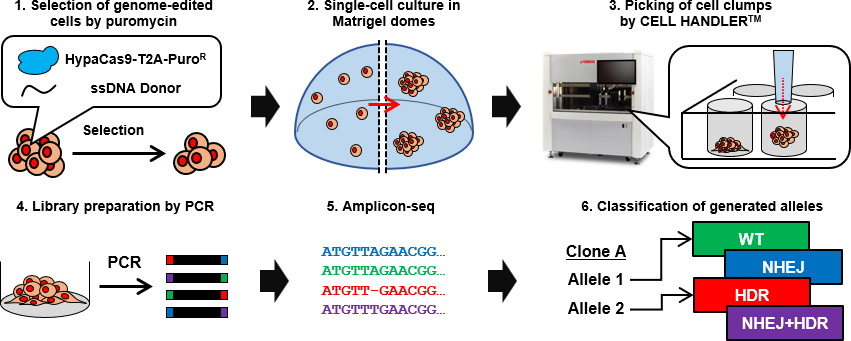
While conventional clone isolation often involves cell handling in a two-dimensional culture, a team of researchers is exploring a new approach that handles clones while maintaining iPS cells in a 3D culture environment. The success of this experiment hinges largely on whether the desired clones can be accurately isolated and harvested from other clones within the gel.
At the Miyaoka Laboratory, part of the Regenerative Medicine Project at the Tokyo Metropolitan Institute of Medical Science, researchers are working to reproduce disease states based on patients’ genetic information using human iPS cells and genome-editing technology. They aim to confirm the causes and mechanisms of diseases in lab experiments. In this interview, we spoke with Dr. Yuichiro Miyaoka about the objectives of the research, experimental challenges in iPS cell research, and the advantages of using the CELL HANDLER™.
Regenerative Medicine Project,
Tokyo Metropolitan Institute of Medical Science
Understanding Disease at the Cellular Level and Expanding Potential Treatments
Q. What led you to your current research theme? When I went to San Francisco for postdoctoral training, I happened to join a lab working on iPS cells and genome editing, which became a turning point for me. My encounter with this research field was partly a matter of chance. But, as I engaged in the work, I became fascinated by the research and how it leads to a deeper understanding of diseases and potential treatments. Understanding disease development at the cellular level and getting to its root causes can lead to curative therapies in the future. This potential drew me to the field and led me to my current research.
Q. What value does the Miyaoka Laboratory aim to deliver to society?
We aim to replicate patients’ genetic diseases using cellular models and gain a deeper understanding of their onset mechanisms. If we can recreate the cellular conditions of a disease in the lab, we can investigate why the disease occurs and test therapies to assess their effectiveness in improving the condition. We believe it is essential to truly understand the disease first through basic research. The better we understand the disease mechanisms, the more treatment approaches we will have. I believe that understanding process and mechanisms of diseases is of the utmost importance.
Accumulation of knowledge and understanding has potential for drug development. It may even lead to new treatments involving returning cells to patients. My hope is that our research outcome will ultimately benefit patients.
Q. How do you prioritize research topics?
I ask myself whether we can visualize how the research might benefit patient treatment and whether the approach is new. Both factors are important. Simply talking about dreams is meaningless if they are not achievable. I must also strike a balance with feasibility.
In one study, we encountered a case in which members of the same family shared an atrial septal defect, yet some developed different cardiac conditions. By using iPS cells and genome-editing technology to recreate the conditions and accumulate genetic information from patients, we can move past mere “correlation” and closer to “causality.” I place great importance on this approach to research.
Q. What do you think is the current and biggest bottleneck in iPS cell and genome editing research?
The bottleneck is inefficiency in recreating disease models for experiments.
Our research addresses liver and neurological diseases as well as heart diseases. Regardless of the target, the core principle remains the same: “Perform experiments and verify the ways in which genetic information leads to phenotypic outcomes.”
Today, genetic mutation data for diseases is accumulating in clinical settings, but the burden is heavy on those conducting cellular experiments to verify this information. So, it is also crucial to establish a framework that enables efficient verification of disease-state reproduction using iPS cells.
Expectations for the CELL HANDLER™ — A Platform That Streamlines iPSC-based Disease Models
Q. What led you to use the CELL HANDLER™, and what role does the device play in your research? It all started with a referral from a partner company. We were already conducting joint research with a company that specializes in cell sorters, and they first told us that Yamaha Motor had an excellent instrument. With the cell sorter’s approach, isolating iPS cells induced cell death, which made it unsuitable for our experiments. The CELL HANDLER™ was the perfect fit for our workflow, where we want to visually check, select, and pick cells under 3D culture conditions. We use the Yamaha instrument to isolate clones after genome editing of iPS cells. We were amazed that it could isolate the desired clones without contamination while visually confirming the actual iPS cell population.
Q. What are the pros and cons of 3D culture compared to colony manipulation in 2D culture?
When a large number of clones are required, I feel that working in 3D allows us to obtain more clones from a single well. Because the 3D clone yield is greater than with 2D cultures, the 3D approach offers clear advantages in throughput. On the other hand, 3D is more labor-intensive. However, as the number of clones increases, we could potentially reduce the amount of culture medium required, so 3D culture may present economic benefits under certain conditions.
The biggest hurdle may be whether your research environment is compatible with the CELL HANDLER™ workflow. On the flip side, if you have a compatible environment, it’s easy to see the benefits of the instrument, as you can increase the number of clones in 3D while evaluating results.
One of the challenges of 3D culture, unlike 2D culture, is that the positions and conditions of the clones are not uniform. It naturally makes it difficult to consistently perform the entire workflow of locating the desired cells, harvesting only the target ones, and moving on to the next step.
Q. What surprised you most after actually using the instrument?
Initially, I thought it might be very difficult to isolate clones in a 3D culture environment. But sample isolation went smoothly from the start. I was impressed with the device’s ability to target specific clones by precisely controlling the XY- and Z-axes.
The accuracy is very high, and I got the impression that there was no damage to the clones after picking. Optimization is required, of course. But once optimized, the CELL HANDLER™ delivers unmatched precision in recognizing the clone’s position, identifying suitable clones via imaging, and accurately retrieving them. Honestly, I feel that the workflow couldn’t have been possible without the CELL HANDLER™.
What stuck with me, more than just the machine’s capability, was the Yamaha Motor staff’s willingness to take on challenges. Rather than simply drawing a line at the machine’s capabilities, they were willing to try something different and push the boundaries. Thanks to them, we were able to identify the required conditions and see the feasibility of our research workflow during the initial planning phase.
Q. What made you feel that “you couldn’t have done it without the CELL HANDLER™”? In this study, we needed to select and recover specific clones from iPS cells cultured in a 3D gel medium. Previously, it was simply unfeasible to manually target and harvest desired clones in a 3D culture environment. This experiment could not have been possible without the CELL HANDLER™ and its precisely controlled workflow.
Vision for the Future—Conducting Causality-identifying Experiments More Quickly and Reliably
Q. What is your vision for future research?
A lot of information on patient genetic mutations—such as “this patient has an abnormality in this particular part of their DNA”—is coming from the clinical front. Although data is accumulating fast, we often know only the correlation between genetic mutations and disease states, not whether they are the direct cause. The only way to investigate causality is through experimental models, but testing each model is very difficult. That’s why we are exploring ways to streamline this process.
We aim to establish a system to efficiently generate genome-edited iPS cells and to test how genetic information influences phenotypes. Ultimately, we hope to establish the cause-and-effect relationship between diseases and genetic information, thereby contributing to the diversification of treatment strategies and the streamlining of drug discovery.
If we can take candidate genetic mutations identified in clinical settings and evaluate them quickly in the lab, we will then be able to demonstrate which mutations could truly serve as therapeutic targets. Establishing a “testing platform” for this purpose will become increasingly important.
Q. What are your expectations for the CELL HANDLER™?
In my opinion, the key advantage of the CELL HANDLER™ is its ability to perform both microscopic observation and cell isolation all within itself.
Conventional cell sorters offer high throughput, but it is often difficult to sort cells while monitoring, for example, cell behaviors and temporal changes. The CELL HANDLER™ allows us to select cells while observing their state over time. I believe it will enable cell selection from a perspective that was not previously possible.
For example, imagine that the system can continuously capture images, automatically identify cells that meet specific criteria for dynamic behavior or temporal changes, and then proceed directly to cell isolation and harvesting. This can lead to the establishment of new evaluation methods.
We hope to see the CELL HANDLER’s range of cell feature parameters expand to include more unique aspects. We look forward to seeing the instrument widely used in research labs.
 Applications
 Brochure
 Contact us
